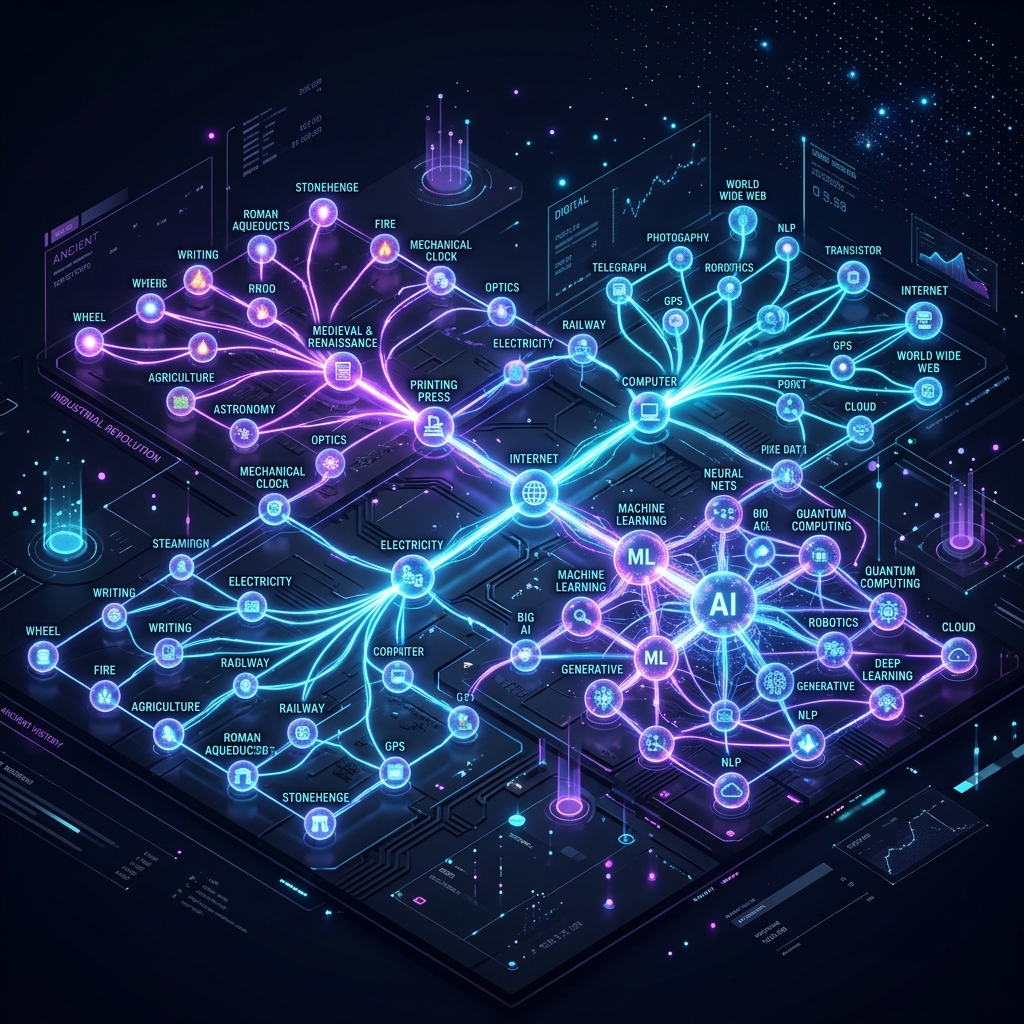
Timelines show inventions as a list. They are really a network. Almost everything was built on several older things.
The problem
I wanted a map you could wander through, not a page you scroll. The data set grew to 715 inventions, 1,817 links between them, and 9 clusters such as computing, medicine and energy.
That is too many lines for a naive renderer. It also had to stay open for other people to add to, which meant the data could not be buried in the code.
The idea came from The Thinking Game, DeepMind's documentary about how thinking systems evolve.
What I built
The first two versions were single HTML files, 35 KB and 49 KB. They still sit in the repo under original/. The current version is a React app that draws the network on a 2D canvas.
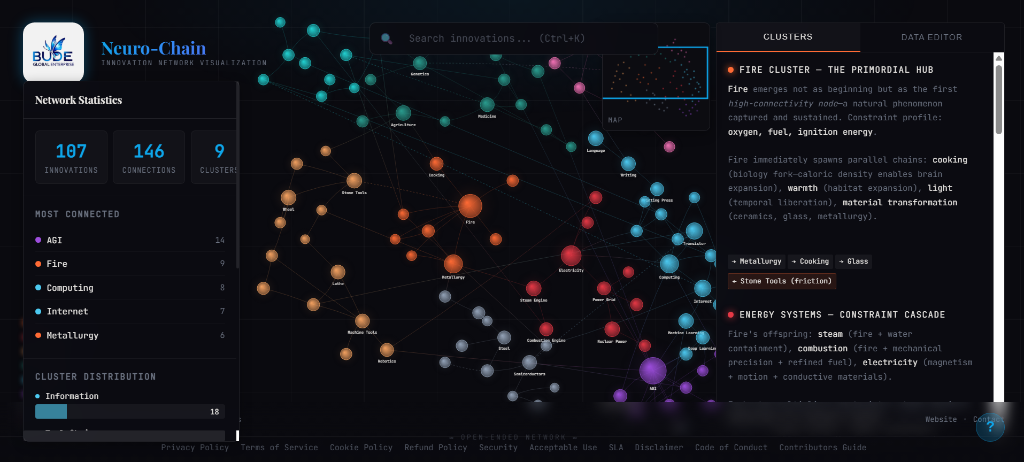
An earlier build of the network view, with 107 of today's 715 inventions.
The unusual part is the hand control. Hold a hand up to the webcam and you can move and zoom the map without touching anything.
webcam frame
 └─ Web Worker: MediaPipe Hands
      landmarks → features scaled by palm size
      → a confidence score per gesture → smoothing
 └─ state machine: IDLE → POTENTIAL → ACTIVE → EXIT
 └─ IntentBus: pan / zoom / select
 └─ canvas: cull to the viewport, draw by level of detail
Decisions that mattered
A canvas, not DOM nodes. 715 nodes and 1,817 edges as SVG elements would make every frame slow. The canvas renderer accounts for the screen's pixel ratio, uses a spatial hash to draw only what is in view, and lowers detail as you zoom out.
Gestures off the main thread. Hand tracking and gesture scoring run in a dedicated Web Worker. The main thread only receives results, so the map keeps drawing while the camera works.
Make a passing hand harmless. A raw detection does nothing on its own. Features are scaled by the size of the palm, so distance from the camera matters less. Each gesture gets a confidence score with a soft threshold, and the smoothing trusts low-confidence frames less. A gesture must then be held for a set time before it becomes active, and it gets a cooldown after it ends.
An intent bus between hand and map. The gesture layer publishes intents. The renderer subscribes to them and never needs to know a hand was involved.
Less detail while you move. While a gesture is active, the renderer draws at most 200 edges and thins the lines. Detail comes back when the hand stops.
Data as plain JSON. Nodes, edges, clusters and descriptions are separate JSON files. A contributor can add an invention with a pull request and never open the rendering code.
What was hard
Hands are noisy. Landmarks jitter between frames, lighting changes, and people move in and out of view. Most of the gesture code exists to decide what not to act on.
Running it as an open project was its own work. I opened 105 issues labelled "good first issue". Eight outside contributors got pull requests merged: Chinese and Spanish translations of the README, UI fixes, node metadata and a test for the data editor. The README is also available in Tamil and Hindi.
The README has drifted from the code. Its badges still say React 18, D3 and TypeScript. The project is React 19 in plain JavaScript, with no D3.
Where it stands
Live at invent.budeglobal.in, deployed on Cloudflare, licensed GPL-3.0. Vitest covers the intent bus, viewport culling, export helpers and the data editor. It installs as a PWA.
The last commit was in June 2026. More than a hundred issues are still open.
The repo is tagged vibe-coded, and that is accurate: much of the code was written with AI assistance.